
Articles
Articles
Articles
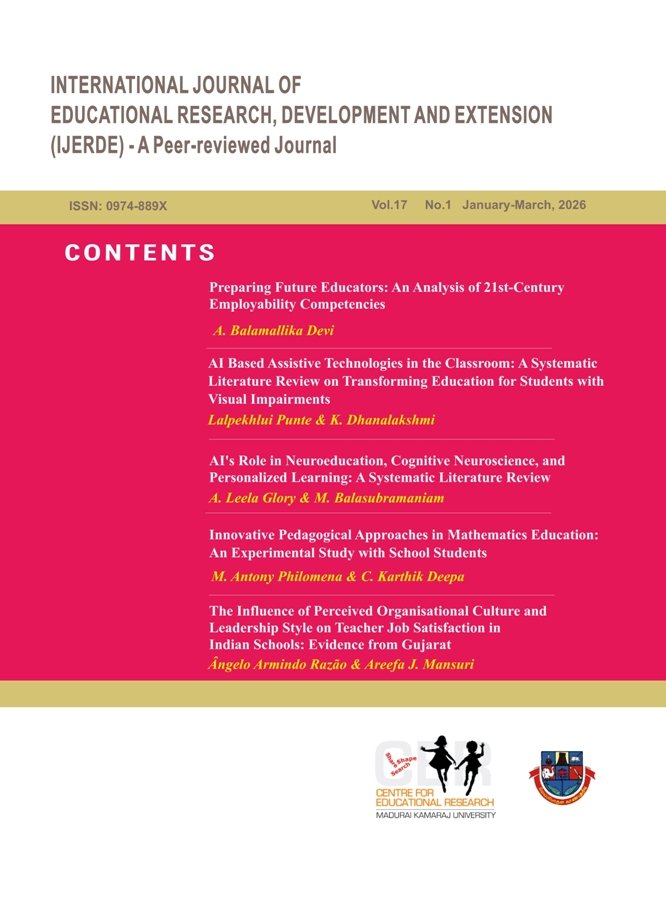
AI Based Assistive Technologies in the Classroom: A Systematic Literature Review on Transforming Education for Students with Visual Impairments
Abstract
This study examines AI based Assistive Technologies and its role in enhancing the participation an overall experience of students with visual impairments in the classroom and educationalenvironment, it has been analysed into five key themes which are, personalized learning, accessibility and navigation, classroom communication and participation, real-time feedback and assessment, and teacher training. According to different research, multiple AI based tools such as screen readers, navigation devices and applications, smart glasses, and more have significantly improve the students participation by providing information and immediate support through accessible formats, these technologies enhances the student’s independence and confidence which eventually enhance their classroom participation and overall experience. However, pedagogical and professional development has to be implemented for the teachers. The study concludes that while AI is a powerful tool for creating more inclusive and equitable learning environment, institutional support and training should be prioritize to bridge the gaps in educator knowledge and resources.
Articles
AI’s Role in Neuroeducation, Cognitive Neuroscience, and Personalized Learning: A Systematic Literature Review
Abstract
The field of education is drastically improving every day in this technical era, where AI is utilised in real-time to help learners who face challenges by designing adaptive learning systems. By comprehending the principles of Psychology, Education, and how the brain processes and analyses information, the field of Neuroeducation emerged. Cognitive Neuroscience is the integration of Neuroscience and Psychology that studies the biological and mental processes of the brain. The role of AI-driven interventions is a field in education that has already been implemented and enhanced the individual learning outcomes of individuals by improving personalized learning, whereas the role of AI in Neuroeducation and Cognitive Neuroscience has carried out studies based on performance level and span of engagement, but very few studies have been carried out in relation to Cognitive, Metacognition criteria such as Retention and Attention span. The study on another very important aspect of Self-regulation has also not been covered in many studies. This gives rise to a gap if personalised learning with AI-enhanced technology actually lines up with how the brain carries out activities like analysing information and learning content. A Systematic Literature review has been done to analysewhether AI-enhanced technologies actually support or do not include Neuroeducation methods that can enhance learning outcomes in individuals and improve a personalised style of learning.
Articles
Innovative Pedagogical Approaches in Mathematics Education: An Experimental Study with School Students
Abstract
An experimental investigation of the potential for introducing new pedagogical approaches to the implementation of gamification, inquiry-based learning and visualization with the support of technology as a way to improve students' performance in mathematics in the post-primary phase (4th – 6th grade). 120 students were randomly assigned to two groups: experimental group (Gamified algebra Instruction using SDT & FT) and control group (Traditional algebra Instruction on lecture). Using ANCOVA analysis, the post test scores of the experimental group were significant higher when compared with the pre test scores with the same values being applied to the control group. Qualitative data from student reflection showed increased engagement of students and decreased math anxiety. Results show that theory-based gamification can make abstract math accessible, motivating experiences, with scalable strategies for various classroom settings. There are implications for teacher training and curriculum design that offer a balance of digital tools and collaborative problem-solving to develop 21st Century mathematical skills.
Articles
The Influence of Perceived Organisational Culture and Leadership Style on Teacher Job Satisfaction in Indian Schools: Evidence from Gujarat
Abstract
The present study is an attempt to investigate the impact of perceived organizational culture and leadership style on Teacher Job Satisfaction in Secondary Schools of Gujarat state, India, and empirical data are collected from Gujarat. Using existing theories of organizational culture and leadership the study examines the relationship between the following key dimensions of culture (adaptability, consistency and involvement) and leadership styles(transformational, transactional and laissez-faire) with the general job satisfaction of teachers. A quantitative cross-sectional research design was used, and secondary school teachers were sampled and used questionnaires which were standardized. The statistical analyses were performed to find out the predictive relationship between organizational culture and teacher job satisfaction for the purpose of leadership style. The findings help to gain a better understanding of the role of school leadership practices and school culture in Indian education on teachers' professional well-being. The study also provides implications for educational leadership and school management that can promote teacher satisfaction and school effectiveness.